Saturday, September 26, 2015

The Love of Money and the 10 Commandments

For the love of money is a root of all kinds of evils. It is through this craving that some have wandered away from the faith and pierced themselves with many pangs. (1Timothy 6:10 ESV)
This text tells us that all types of evil are rooted in the love of money. One might relate this to the Marxist claim that man is essentially an economic being, yet I think it goes deeper than this. While economics plays a major part in motivating human behavior it cannot be the ultimate motivation. Rather, man is essentially a worshiping being. God created human beings to bring him glory. Money comes into the picture because, as fallen mankind is apt to do, we create an idol out of it. We worship the security and the pleasures that money can bring. As I thought about this reality, I wanted to see how the 10 Commandments fit into this equation. The 10 Commandments are a summary of the moral law, so if the love of money is the root of all evils, then we can expect that it may motivate the violation of each of the commandments.

1. You shall have no other gods before me.
According to Jesus, the whole law is summed up in the commands to love God with all your heart and to love your neighbor as yourself. Yet, as sinful human creatures we fall short. We do not love God as we ought to love him. When we find our security, our comfort, or our meaning in something other than him we have committed idolatry. We are worshiping something other than the one true God. Money is easily worshiped. You don't have to bow down or have religious ceremonies to worship money. You just have to treasure it more than Jesus.
2. You shall not make for yourselves any graven image.
 Initially, this commandment seems more difficult to tie to the love of money. Yet Jesus asked whose image was on a coin in his day. It would be wrong to claim that the minting of coins violates this command; however, when our devotion is to money, our hearts care more for the image on a coin than the image of God in our fellow man.
3. You shall not take the name of the LORD your God in vain.
 If we say we worship God, yet we really only treasure the gifts that He gives. If we value His gifts above Him, then we take his name in vain. Taking God's name in vain is more than just using it as a curse word, it is using God's name emptily. To claim to worship Him when He is not our highest treasure is to violate this command.
4. Remember the Sabbath Day, to keep it holy.
 How often do we let our service of money stand in the way of our observance of rest and worship? The principle of the Sabbath is not easily transferred to New Testament believers. Not everyone understands the application of this command for today in the same way. However, at the very least we can say that when we allow the constant pressures to work stand in the way of making time for rest and worship we have allowed money to be our God.
5. Honor your father and mother.
 Jesus connects this command to money when he confronts the religious teachers about holding their traditions above God's word. To honor one's father and mother means to care for their needs and to provide for them in their old age when necessary. The love of money might keep some from fulfilling this duty.
6. You shall not murder.
The love of money might motivate some to kill for it.
7. You shall not commit adultery.
 One might not easily connect the love of money and the sin of adultery; however, when one considers that the from 2001 to 2007 the pornography industry in the US alone went from a $1 billion a year industry to a $3 billion industry, it is easier to see the connection. Young women who were created in the image of God, to worship him, and to bring him glory, are selling their bodies for the sake of the love of money.
8. You shall not steal.
This may be the easiest to relate to the love of money. People will take what does not belong to them because they love money more than they care about another human being created in God's image.
9. You shall not bear false witness.
It is often the idol of security that may cause someone to lie for the sake of personal gain or protection from material loss.
10. You shall not covet.
Coveting = Loving money (or material things) more than God or neighbor.

There are some of the commandments that are easier than others to relate to the love of money. I am sure that there are many aspects that I left out. I merely tried to show that there was some kind of connection to each of the commandments. Beware of the love of money. It is an internal enemy that is capable of pulling us into a pit in which we will be impaled upon many sorrows.


Sunday, September 13, 2015

"True Religion" Caring for Widows: 1 Timothy 5:1-16

There is a very important place within the life of Christians for caring for widows. James, the brother of Jesus, made the point by stating that caring for widows was at the heart of true religion. Paul gives Timothy instructions on caring for widows. The office of deacon was first instituted so that churches would be able to effectively care for widows without neglecting preaching and prayer, and Jesus commended the faith of the widow who gave all she had.


Thursday, September 10, 2015

The Big Picture

Tonight I recommended a children's Bible...to an adult...and not for her kids...for herself.
There's no shame in this. Fifty years ago, when you talked with someone about the Bible, the chances were they had some frame of reference to understand what you were talking about. It's just not that way today. We no longer live in a culture that shares a common understanding of what the Bible is.
This brings a challenge to us when we do evangelism today. We use our church language and expect that people know what we are talking about...but they often don't.

Case in point (I'll spare details for the sake of privacy), I was having a conversation with two other people. One was a mature believer, one is just beginning to seek Christ. The seasoned believer encouraged this young sister to read her Bible...and not to forget the Old Testament...that's important too. Now, I agree with this mature assessment about the necessity of the Old Testament for the life of a believer. I mean, I've spent years studying Hebrew and got half way through the coursework for a PhD in Old Testament. Believe me, I affirm the need for the Old Testament. Later...when it was just me and the new seeker...I brought this up again and asked..."Do you know the difference between the Old and the New Testaments? The answer was no. When we've been in church so long we often take little things like this for granted.

I spent the next 5 minutes trying to give an explanation of the contents of the Old and New Testament. I started with the New, and I explained that it begins with the 4 Gospels. Each of the Gospels tells the story of Jesus life and ministry through his death and resurrection. I told her that they aren't in chronological order, but rather they each tell the same story from 4 different perspectives. Next comes Acts. This is the story of the next 30 years or so after Jesus ascended into heaven. It tells the story of the apostles taking the message of Jesus throughout the world. Next come letters to specific churches and individuals that are intended to address specific situations. Finally, Revelation is probably the most difficult because it is filled with symbolic imagery and it is about the things at the end--things in the future.

Then I turned to the Old Testament. I didn't take the time to break down the divisions of Law, Prophets, and Writings. Rather, I just told her that the Old Testament is important because it is how we know that Jesus didn't just plop out of the sky one day from nowhere. Rather, it was the unfolding of God's plan throughout thousands of years. I told her that it tells the story of God working among the Jewish people, promising a Messiah who would one day come. I concluded by saying that the two parts of the Bible can basically be summed up with Promise and Fulfillment.

Imagine, if you were an alien from a distant planet and you came here. Assuming this is in the world of Star Trek where all planets speak English, you are familiar with literature, but only one genre--Children's Books. When you arrive here on earth you quickly find a library and randomly pick up a book assuming that it will be a children's story; however, you soon find the book difficult and give up because it was actually a technical manual for repairing an automobile. This technical manual does not follow the rules of the children's book genre, so you give up, assuming that it is too difficult and you can never understand what is so entertaining  about the story.

This is what reading the Bible can be like. When we come to the Bible, we have to realize that it is written in several different genres over the course of thousands of years. There is great diversity within the biblical corpus, and it is an ancient document that is very foreign to modern readers. For those of us who grew up with the Bible stories in Sunday School from our childhood, we can navigate the Bible with some level of ease. At least we know what it is we're looking at. But think of what it must feel like for someone coming to the Bible for the very first time without any knowledge at all of what it is all about.

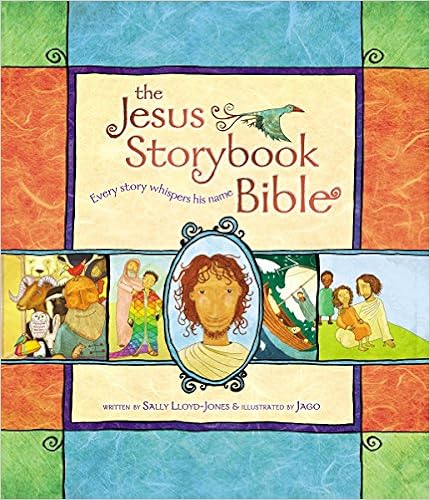
People have to have a reference point. We have to have some kind of idea of what it is we are reading before we can understand what something big and complex is all about. When a child is leaning to read, they always look for the pictures to get some idea of what it is they are looking at. Children's books are filled with pictures. This isn't something that is necessary for children only. It can be very helpful for adults as well. I'm not saying that we can be content with just a children's book, but how about instead of telling new believers to start with the book of John, we get them a copy of the Jesus Storybook Bible so they can at least have some idea of the big picture of what the Bible is about.

So I recommended it. I recommended the Jesus Storybook Bible to an adult, just beginning to seek Christ. And I would suggest, that when you have conversations with others that have limited understanding of the Bible, you might want to do the same thing. Start with a children's storybook Bible that can sketch the main story line of the Bible. We all have to see the big picture before we can make sense of the details.

Sunday, September 6, 2015

A Good Servent of Christ Jesus: 1 Timothy 4:6-16


The greatest desire of the heart of any disciple of Jesus Christ ought to be that we might be called a good servant. This is true for all believers, but it is especially true for pastors. In 1 Timothy 4, Paul is instructing Timothy on his duties and priorities of a pastor, and he tells Timothy, as well as any pastor who comes after him, how to be a good servant of Christ.


1 Timothy 4:6 If you put these things before the brothers, you will be a good servant of Christ Jesus, being trained in the words of the faith and of the good doctrine that you have followed.
 7 Have nothing to do with irreverent, silly myths. Rather train yourself for godliness;
 8 for while bodily training is of some value, godliness is of value in every way, as it holds promise for the present life and also for the life to come.
 9 The saying is trustworthy and deserving of full acceptance.
 10 For to this end we toil and strive, because we have our hope set on the living God, who is the Savior of all people, especially of those who believe.
 11 Command and teach these things.
 12 Let no one despise you for your youth, but set the believers an example in speech, in conduct, in love, in faith, in purity.
 13 Until I come, devote yourself to the public reading of Scripture, to exhortation, to teaching.
 14 Do not neglect the gift you have, which was given you by prophecy when the council of elders laid their hands on you.
 15 Practice these things, immerse yourself in them, so that all may see your progress.
 16 Keep a close watch on yourself and on the teaching. Persist in this, for by so doing you will save both yourself and your hearers.

The first thing that Paul says that pastors must do to be a good servant of Christ is to "put these things before the brothers." This begs the question, "what things?" In the previous verses, Paul warned that in the last times false teachers would depart from faith and be devoted to teachings of demons. This teaching was characterized by an obsession with asceticism. In contrast, Paul points to the biblical doctrine of creation and states that foods were made holy "by the word of God and prayer." I would suggest that "these things" refers to sound biblical doctrine that isn't based on superstition or man made wisdom but is grounded in the Bible.

Verses 6-10 continue to confirm that this is what "these things" is talking about. Paul says that Timothy has been trained in the "words of the faith" and the "good doctrine" which he has followed. Again, Paul is pointing Timothy to the Scriptures.

In verse 11, Paul continues the emphasis on Scripture. He says "command and teach these things." It seems he is talking about the same things as he referenced in verse 6, and then in 13 he gives specific instructions on how to carry out his charge. He says to give attention to public reading of Scripture, to exhortation, and to teaching. Timothy has been charged to read the Bible publicly. This is something we don't do often enough today. There are some churches you can go to and Scripture is rarely ever read publicly more than a verse or two, and sometimes it is hard to find scripture read even during the sermon. A faithful servant of Christ will give a prominent place to the reading of Scripture as he leads the people of God in worship. But Timothy wasn't merely to read it, but he was to exhort the people with it. In other words, he was to labor to convince the congregation by words and with passion to obey and believe the biblical teaching. Paul also instructs Timothy in verse 13 to give attention to teaching or doctrine. Paul was convinced that the Scriptures presented a unified message that was consistent throughout. With this understanding of the nature of Scripture one can come to it and arrive at an understanding of what the Bible teaches about any given topic. Here Paul tells us that we are to pay attention to doctrinal orthodoxy. It isn't enough just to read the Bible and exhort people to obey it, but we must also be careful to teach what is in conformity to orthodox doctrine..

So far as we've looked at the passage, Paul instructs Timothy to oppose error (unbiblical doctrine), and to give attention to biblical teaching, but neither of these are enough. In verse 16, Paul tells Timothy, "Keep a close watch on yourself and on the teaching." Paul's concern isn't merely doctrinal orthodoxy, but it is on the person teaching as well. Paul had already exhorted Timothy to discipline himself for godliness, and this makes up the third element required for all good servants of Christ Jesus. We must watch both our lives and doctrine.

So, in summary, Paul's exhortation to Timothy in these verses is to 1) confront false teaching, 2) commit himself to the Bible, and 3) have a character of purity. This is our charge as well. We must have the courage to call out false teaching when others would think that we are being judgmental or too "restrictive." We must have the commitment to Scripture that keeps us chained to the Bible that we do not leave it behind for the latest whims of the world. We must watch our lives, and we must fight the battle with the flesh, that we may live lives of holiness in the fear of God.

Sunday, August 30, 2015

Worship and Warning, A Meditation on Psalm 95


To casually read through Psalm 95 you would think that there were two separate psalms that were spliced together. The first half seems to have a far different character from the second half. It begins with a call to worship our Creator God for his goodness, his sovereignty, and his salvation. Yet, beginning in verse 8, the psalm turns to a dire warning of judgement. I will not suggest that these were two documents that were spliced together haphazardly. Rather, the psalm does cohere together. It make sense as it is.

Throughout the book of Psalms, there are often two ways presented. Beginning with Psalm 1, the psalmist contrasts the way of the blessed man whose delight is in the Law of God and the way of the wicked who will not stand in the judgement. This theme flows throughout the book of Psalms. I believe that we can look at Psalm 95 through this lens and the pivotal verse is verse seven.
  Psalm 95:1 Oh come, let us sing to the LORD; let us make a joyful noise to the rock of our salvation!
 2 Let us come into his presence with thanksgiving; let us make a joyful noise to him with songs of praise!
 3 For the LORD is a great God, and a great King above all gods.
 4 In his hand are the depths of the earth; the heights of the mountains are his also.
 5 The sea is his, for he made it, and his hands formed the dry land.
 6 Oh come, let us worship and bow down; let us kneel before the LORD, our Maker!
 7 For he is our God, and we are the people of his pasture, and the sheep of his hand. Today, if you hear his voice,
 8 do not harden your hearts, as at Meribah, as on the day at Massah in the wilderness,
 9 when your fathers put me to the test and put me to the proof, though they had seen my work.
 10 For forty years I loathed that generation and said, "They are a people who go astray in their heart, and they have not known my ways."
 11 Therefore I swore in my wrath, "They shall not enter my rest."
Verse 7 causes me to struggle. Now I know that the verse divisions were not original, so it doesn't really bother me that in the English translation it appears that there is a sentence that begins in verse 7 and ends in verse eight. Originally the text would have been purely consonantal, and it would have run together without even spaces dividing the words. I'm thankful for the way our modern language has made it easier to read things with spaces, vowels, and punctuation. However, when I look at verse 7 in the Hebrew text, the verse is one whole sentence, separate from verse eight. This was a judgement call. The Masoretes, who gave our current Hebrew texts the vowel pointing and accent system appear to have thought that the end of verse seven belonged with the beginning. This does not necessarily mean that the Masoretes were right. The Septuagint (LXX), the Greek translation of the Old Testament--the one which was often quoted by the New Testament authors--clearly took the end of verse 7 along with verse eight.

What's the difference? If verse 7 is to be taken as a whole it says, "He is our God and we are the people of his pasture, the sheep of his hand, today, if you hear his voice." There's a subtle difference here, isn't there? I'm not going to suggest that this is definitely the right way to read this text. The commentaries I've looked at do not take it this way, and a friend of mine who is finishing his PhD in Old Testament isn't convinced either. However, I will say that it has at least alerted me to the idea that the end of verse 7 is a transition between the worship and the warning of the overall psalm.

The two ways are contrasted in the Psalm. It begins with a call to worship. It calls us to give a cry for joy--like a war cry that is triumphant in battle to the LORD, the God of our salvation. It calls us to worship him because he is above all other gods, and he created all things, and he holds all things in his hand. It calls us to bow down and prostrate ourselves in front of the face of our Maker, BECAUSE He is OUR God, and we are the people of His pasture. Herein lies the reason for praise. These are the things that the psalmist is saying to the righteous. However, he transitions with a conditional clause. IF you hear his voice. This reminds me of when Jesus said, "my sheep here my voice." We are his sheep, and we are the ones being called into his worship--IF we hear his voice.

In contrast, if we don't hear His voice, it is our own fault--it is because we have hardened our heart. Here the psalmist warns the people of God not to be like the generation that died in the wilderness. We must persevere, and not harden our hearts. We must believe on him and not put him to the test (maybe with our grumbling like the rebels at Meribah). He warns that that generation had a heart that wandered, and I too feel, like Robert Robinson the author of Come Thou Fount of Every Blessing, that I am often prone to wander, and "prone to leave the God I love." Here the psalmist gives us a warning not to be like that, and the consequence is that we may not enter his rest.

So, to boil this down I would say it all hinges on our response to God's voice--which we hear in the Bible. When we hear his word, does it cause us to rejoice? Does it cause us to worship? Or, do we respond with hardness? Do we come up with reasons why we think it isn't a big deal? Do we justify and rationalize reasons why it doesn't apply to us.

Today, let us hear the warning from the psalmist. Listen to his voice, and you are his sheep. Harden your heart, and he never knew you.


Tuesday, August 25, 2015

Revive Us Again, A Meditation on Psalm 85


Psalm 85:1 To the choirmaster. A Psalm of the Sons of Korah. LORD, you were favorable to your land; you restored the fortunes of Jacob.
2 You forgave the iniquity of your people; you covered all their sin. Selah
3 You withdrew all your wrath; you turned from your hot anger.
This Psalm begins with a recollection of God's saving acts in the past. The author recalls that the Lord has been favorable to his "land." This brings to mind the land which God created in Genesis 1 as well as the land that was promised to Abraham and his family. He also recalls how God had restored the "fortunes" of Jacob. The precise translation of this word, "fortunes" is debated because the Hebrew could come from two different roots. The KJV renders it "captivity," while the ESV renders it "fortunes." Regardless of which rendering, it seems that the verse is a reference to the Exodus of God's people, the sons of Jacob being brought out of Egypt and given a land.

You "forgave" is literally, you "lifted" the iniquity or guilt of your people. It was lifted up and taken away. You "covered" all their sin shows that God has covered it up and hidden it from his view. The word "all" must not be forgotten. He didn't merely cover some of his people's sin, he covered all of it.

Then it says that God gathered up all of his fury. His fury had troubled his people, yet he gathered it up and restrained it from troubling them any longer. He also "turned" from his hot anger. The word "turn" is repeated several times in this psalm. It was the word used to say that God "restored" the fortunes of Jacob, and it occurs several more times. When speaking of human beings it can mean repentance, and here it is used of God to say that he changed his inclination toward his people. He had been angry with them, but he turned from this anger.

 4 Restore us again, O God of our salvation, and put away your indignation toward us!
 5 Will you be angry with us forever? Will you prolong your anger to all generations?
 6 Will you not revive us again, that your people may rejoice in you?
 7 Show us your steadfast love, O LORD, and grant us your salvation.
In the word "restore" we see another repetition of the word "turn." It says that God had "turned" from his anger, and now the prayer begins, "turn us." Turn us, or cause us to repent. If we are to experience the joy of God's salvation, and his indignation is to be put away, he must work in our hearts and cause us to repent.

The psalmist asks a series of rhetorical questions expecting a negative answer. He expects God to say, "no, my anger will not last forever, it will not extend to all generations, but I will 'revive' my people that they would rejoice in me." To revive uses the word for "turn" again. It literally says, "Return our life." That's what revival is. When we pray for revival, we are asking God to give life to that which is dead. When the psalmist asks for revival, he is expecting God to act, and he gives a God-centered justification for his request. He bases his plea in the desire that God would be delighted in.

The psalmist then asks that God would show, or reveal, or make seen his "steadfast love." This word has been the subject of much scholarship. It is to be understood as the covenantal loyal love of God. God is in a covenant with his people, and he must show his love with them because he has promised to. The psalmist is asking to see revival on the basis of God's own promises.
 8 Let me hear what God the LORD will speak, for he will speak peace to his people, to his saints; but let them not turn back to folly.
 9 Surely his salvation is near to those who fear him, that glory may dwell in our land.
 10 Steadfast love and faithfulness meet; righteousness and peace kiss each other.
 11 Faithfulness springs up from the ground, and righteousness looks down from the sky.
 12 Yes, the LORD will give what is good, and our land will yield its increase.
 13 Righteousness will go before him and make his footsteps a way.
After recounting God's saving acts in the past and asking that God would do it again on behalf of his people, the psalmist ends with an expression of confidence that God will act. He requests that he would hear from God and confidently states that God would speak peace to his people. He follows this statement with the hope that the sinful people would not again return to the false confidence of trusting in their own righteousness. Rather, says that the one who fears God will experience his salvation.

"Steadfast love" is God's loyal covenantal love, and faithfulness is word for truth we often translate as truth. So in verse 10 we see that God's love and truth meet together. These are attributes that at first blush seem to be opposing one another, yet they meet together here. Then righteousness and peace kiss each other. Again, we see two attributes of God, his righteousness and justice set against peace, and they kiss each other. This verse is describing the reconciliation of what seems irreconcilable--God's justice and his grace. Verse 10 describes what we see in the cross as God's justice was satisfied and the guilty were reconciled with God.

In verse 11, truth comes up from the ground, and righteousness looks down--and God's people are not destroyed by it because they are sheltered under his merciful covenantal love. Verse 12 says that the Lord will give what is good and the land will give produce. This hearkens back to Genesis 3. The results of the curse included that the land would not produce as it should, but here we read of an expected reversal of this curse--where the land will produce good.

Finally we see that righteousness is personified as someone who walks before God and makes a way. Jesus IS righteousness personified, and he specifically said that he is the way.


Saturday, August 8, 2015

The Righteous Judge


Years ago, the most commonly quoted Scripture verse was probably John 3:16; however, in our culture today, it is probably now “Judge not.” These two words are not quoted within their full context as a warning against harsh or hypocritical judgment, rather they are thrown up as a trump card against any kind of moral critique. Christians are told to speak the truth in love, and sometimes that means warning others about their sin, yet often the warning is met with this “trump card,” as an absolute prohibition against judging. 


Similarly, someone might respond, “you can’t judge me, only God can judge me.” This response misunderstands the nature of God. It is true, God is the ultimate judge, yet when used in this way it seems to suggest that God will not do so, when the opposite is clearly taught in Scripture. God is a righteous judge, and he is furiously angry with sinners. To say, “only God can judge me” in a flippant way is to take God’s name in vain. Only a practical atheist could say such a thing without trembling at the thought. 


Yet the thought of God as the righteous judge is a good thing for the believer. In Psalm 7 we see David express his praise to God because of his righteous judgement.
David finds his refuge in God and trusts that he will be vindicated of false accusations as the righteous judge punishes his accuser.

Apparently, David was falsely accused by this Cush, a Benjaminite. We don’t know who this is. He is not mentioned in the narrative stories about David. However we do read of at least two times when David’s life is in danger as he is pursued by an enemy. It could be while he is pursued by Saul, who was also of the tribe of Benjamin, or it could be during his flight from his son Absolom. Or, it may be following the death of Saul, when one of Saul’s relatives was falsely accusing David of unjustly murdering Saul.

Here's What the text says: 
O LORD my God, in you do I take refuge; save me from all my pursuers and deliver me,
2 lest like a lion they tear my soul apart, rending it in pieces, with none to deliver.
 3 O LORD my God, if I have done this, if there is wrong in my hands,
 4 if I have repaid my friend with evil or plundered my enemy without cause,
 5 let the enemy pursue my soul and overtake it, and let him trample my life to the ground and lay my glory in the dust. Selah
 6 Arise, O LORD, in your anger; lift yourself up against the fury of my enemies; awake for me; you have appointed a judgment.
 7 Let the assembly of the peoples be gathered about you; over it return on high.
 8 The LORD judges the peoples; judge me, O LORD, according to my righteousness and according to the integrity that is in me.
 9 Oh, let the evil of the wicked come to an end, and may you establish the righteous-- you who test the minds and hearts, O righteous God!
 10 My shield is with God, who saves the upright in heart.
 11 God is a righteous judge, and a God who feels indignation every day.
 12 If a man does not repent, God will whet his sword; he has bent and readied his bow;
 13 he has prepared for him his deadly weapons, making his arrows fiery shafts.
 14 Behold, the wicked man conceives evil and is pregnant with mischief and gives birth to lies.
 15 He makes a pit, digging it out, and falls into the hole that he has made.
 16 His mischief returns upon his own head, and on his own skull his violence descends.
 17 I will give to the LORD the thanks due to his righteousness, and I will sing praise to the name of the LORD, the Most High. (Psa 7:1-17 ESV)
The fact that God a just judge is a problem for the unrepentant. This text warns that God is sharpening his sword and bending his bow--ready to exact punishment upon sin. This is unpopular, but if the Bible is to be taken as a consistent whole, it's the truth.

On the other hand, it is a good thing for believers that God is a just judge.This isn't because we are righteous ourselves, but because our punishment has already been carried out. That's what the cross was for. God would have been unjust to let sin go unpunished, so we needed a substitute. Jesus took our place on the cross and we have been imputed with his righteousness. It is also a good thing because who would want to live in a world where God was unjust? We want to know that evil is vanquished.